
Controller Features
The Tricon controller is a state-of-the-art programmable logic and process controller that provides a high level of system fault tolerance. To ensure the highest possible system integrity at all times, the Tricon controller includes these features:
Provides Triple Modular Redundant (TMR) architecture whereby each of three identical system channels independently executes the control program, and specialized hardware/software mechanisms “vote” all inputs and outputs.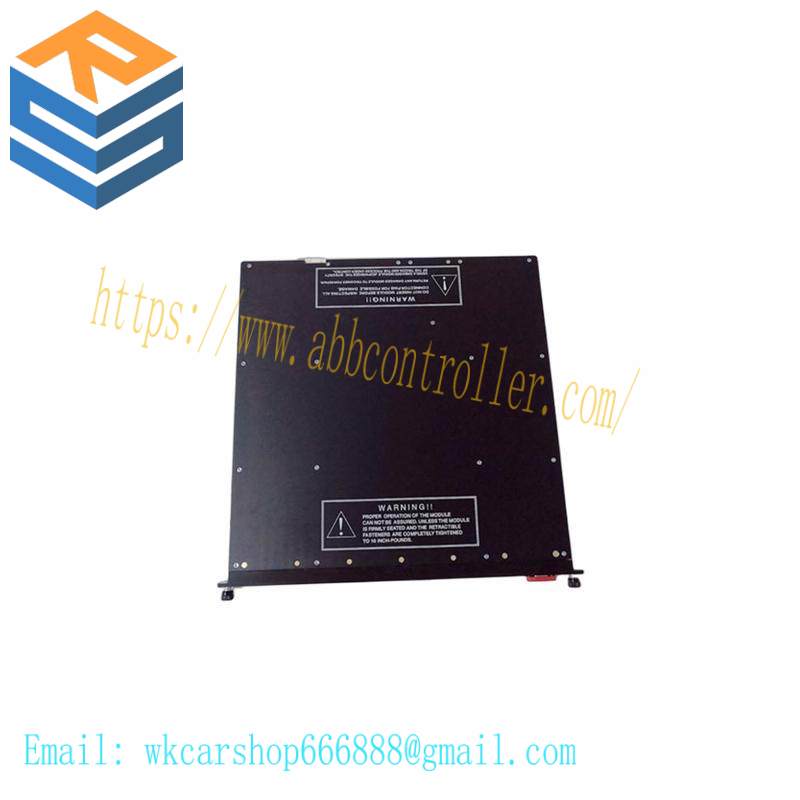
Withstands harsh industrial environments.
Enables field installation and repair to be done at the module level while the controller remains online. Replacing an I/O module does not disturb field wiring.
Supports up to 118 I/O modules (analog and digital) and optional communication modules that interface with Modbus masters and slaves, Foxboro® and Honeywell™ Distributed Control Systems (DCS), other Triconex controllers in Peer-to-Peer networks, and external host applications on Ethernet networks.
Provides integral support for remote I/O modules located as far away as 7.5 miles (12 kilometers) from the Main Chassis, using SRXM modules.
Executes control programs developed and debugged with TriStation™ 1131 Developer’s Workbench Software or TriStation MSW software.
Provides intelligence in the input and output modules to reduce the workload of the Main Processors. Each I/O module has three microprocessors. Input module microprocessors filter and debounce the inputs and diagnose hardware faults on the module. Output module microprocessors supply information for the voting of output data, check loopback data from the output terminal for final validation of the output state, and diagnose field-wiring problems.
Provides integral online diagnostics with adaptive-repair capabilities.
Allows normal maintenance while the Tricon controller is operating, without disturbing the controlled process.
Supports transition to a hot-spare I/O module for critical applications where prompt service may not be possible.
Fault Tolerance
Fault tolerance, the most important capability of the Tricon controller, is the ability to detect transient and steady-state error conditions and to take appropriate corrective action online. With fault tolerance, there is an increase in safety and an increase in the availability of the controller and the process being controlled.
The Tricon controller provides fault tolerance through Triple Modular Redundant (TMR) architecture. The controller consists of three identical system channels, except for the Power Modules which are dual-redundant. Each channel independently executes the control program (also referred to as the TriStation application) in parallel with the other two channels. Hardware voting mechanisms qualify and verify all digital inputs and outputs from the field; analog inputs are subject to a mid-value selection process.
Because each channel is isolated from the others, no single-point failure in any channel can pass to another. If a hardware failure occurs in one channel, the faulty channel is overridden by the other channels. Repairs consist of removing and replacing the failed module in the faulty channel while the Tricon controller is online and without process interruption. The controller then reconfigures itself to full TMR operation.
Extensive diagnostics on each channel, module, and functional circuit immediately detect and report operational faults by means of indicators or alarms. The diagnostics also store information about faults in system variables. If faults are detected, the operator can use the diagnostic information to modify control actions or direct maintenance procedures.
Because the triplicated system operates as one control system, the Tricon controller can be programmed with one control program that terminates sensors and actuators at a single wiring terminal.
System Configuration
Physically, a basic Tricon controller consists of Main Processors and I/O modules, communication modules, the chassis enclosing the modules, field wiring connections, and a TriStation PC. This section briefly describes these components and provides general specifications
Tricon modules are field-replaceable units consisting of an electronic assembly housed in a metal spine. Each module has a protective cover that ensures no components or circuits are exposed even when a module is removed from the chassis. Offset backplane connectors make it impossible to plug a module in upside down, and keys on each module prevent the insertion of modules into incorrect slots. The Tricon controller supports digital and analog input and output points, as well as pulse and thermocouple inputs and multiple communication protocols.
Tricon Controller Chassis
A Tricon controller can include a maximum of 15 chassis, housing any appropriate combination of input, output, communication, interface, and hot-spare modules. There are three types of chassis: Main, Expansion, and RXM.
• The Main Chassis houses the Main Processor modules and I/O modules. The Model 8110 Main Chassis houses up to six slot sets of I/O modules and the Model 8120E Enhanced Performance Main Chassis houses up to five sets of I/O modules. The I/O modules in a chassis are connected via I/O expansion bus ports that are triplicated RS485 bi-directional communication ports.
• An Expansion Chassis (chassis 2 to 15) houses up to eight slot sets of I/O modules and HART™ Interface Modules. The Expansion Chassis connects to the Main Chassis by means of a triplicated RS-485 bi-directional communication port. Generally, the last Expansion Chassis must be located no more than 100 feet (30 meters) from the Main Chassis or an RXM Chassis.
• An RXM Chassis houses a Primary or Remote RXM Module set and six slot sets of I/O modules. An RXM Chassis enables a system to extend to remote locations up to 7.5 miles (12 kilometers) from the Main Chassis, using SRXM modules.
Tricon Controller Field Wiring
External termination assemblies are available for connection to field devices. For additional information on termination products, see the Field Terminations Guide for Tricon v9–v11 Systems.
TriStation Software
TriStation 1131 or TriStation MSW software is required to develop and download the control program that runs on the Tricon controller. TriStation MSW includes Relay Ladder Logic for program development. TriStation 1131 provides three programming languages which comply with the IEC 61131-3 standard: Function Block Diagram, Ladder Diagram, and Structured Text. An optional language, CEMPLE (Cause and Effect Matrix), can be purchased separately.
For more information, see the TriStation 1131 Developer’s Guide for the version being used.
Theory of Operation
Triple Modular Redundant (TMR) architecture ensures fault tolerance and provides error-free, uninterrupted control in the presence of either hard failures of components or transient faults from internal or external sources.
Every I/O module houses the circuitry for three independent channels. Each channel on the input modules reads the process data and passes that information to its respective Main Processor. The three Main Processors communicate with each other using a proprietary highspeed bus system called the TriBus.
Once per scan, the Main Processors synchronize and communicate with their neighbors over the TriBus. The TriBus votes digital input data, compares output data, and sends copies of analog input data to each Main Processor. The Main Processors execute the control program and send outputs generated by the control program to the output modules. The Tricon controller votes the output data on the output modules as close to the field as possible to detect and compensate for errors that occur between the Main Processor and the final output driven to the field.
Each I/O slot can contain two identical I/O modules, which means if a fault is detected on one module, control is automatically switched to the healthy module. A faulty module can also be replaced online when only one module is installed in the slot. In this case, a healthy module is inserted in the spare slot and the control is switched to this module, which allows the faulty module to be pulled and sent for repair.
Related product recommendations:
ABB PPD113B03 3BHE023584R2365
ABB 3BHE020570R1022 PPD114 B1022 AC 800PEC
ABB 3BHE041576R3011 PPD517 A3011
ABB 3BHE041576R3011 PPD517 A3011
ABB PP D113 PPD113 3BHE023784R2630 B01-26-111000
ABB PPD113B01 3BHE023784R1010
ABB PPD113B01-10-150000 3BHE023784R1023
ABB 3BHE024820R0101 PPD234 A101
ABB PPD113B03-26-100110
ABB PPD113 3BHE023584R2634
GE IS220PPDAH1A
GE IS220PPDAH1B
GE IS220PPDAH1A REV E
ABB PPD113B03-26-100110 3BHE023584R2634
More…



Leave a comment
Your email address will not be published. Required fields are marked *